
Manuscripts
Search Filter
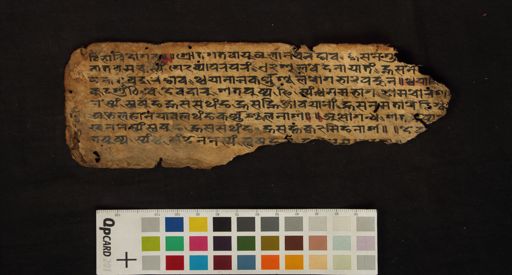
Unknown Medical Fragment
eap_79003034 Language : Sanskrit & Newari Scripts : Nepālākṣara
This is an unknown medical fragments. It has only 6 folios The text has only middle portion, colophone portion is not present here. f.4 has describe śleṣmā (Bulgum) cikitṣā. The text is Heavily damaged several folios has broken so words are not readable.
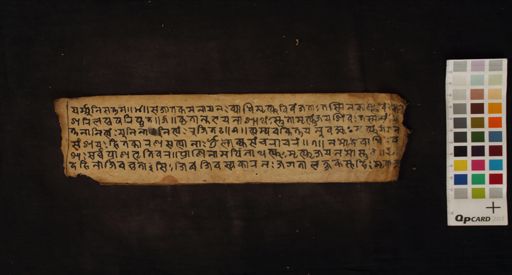
Mṛtyuñjaya Stotra
eap_79003035 Language : Sanskrit Scripts : Nepālākṣara
This is a Stotra text on Hinduism ritual. It describes about Mṛtyuñjaya Stotra, Mṛtyuñjaya is the another name of lord Mahādeva. Any person who is the near of the death or in health issue should recite this stora, so the people will heal and could be win from death, the stotra written in 40 verses. At the colophone part only king Pratāpa Amar name is mentioned. The manuscript is very damaged so some several words and letters are impossible to ascertain.
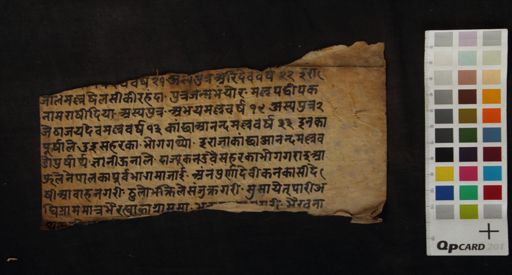
Fragment of Malla Vaṃśāvali
eap_79003036 Language : Newari Scripts : Nepālākṣara
This is a narrative text of Malla dynasty of Nepal. The text describes the lineage of malla king Aridevmalla (22) - his son Mallapadipaka- his son Abhayamalla (19)- and his two son Jayadevamalla (13) and Ānandamalla (33). Ānanda Malla was a king of the Malla dynasty in the Nepal region, and his reign is associated with the development of temples and structures like the Paśupatinātha Temple. There are several places has mentioned including; Kohigrāma Cakoraṣīkāśrama, and Bhaktapura. The Manuscript is heavily damaged some portion are broken and only 2 folios so its not possible to confirmed their dynysty period and other disciples name.
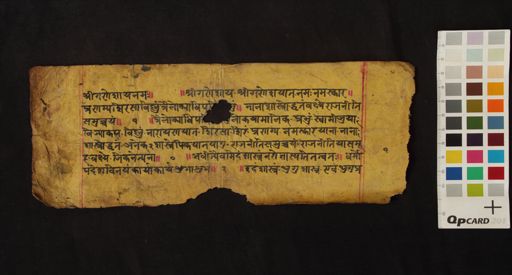
Composite Text (Bhṛguśāstra Unknown Buddhist Stotra Fragment of Jyotiṣa Buddhist Dhāraṇī lakṣacaityayakathā Sakatāpātha)
eap_79003037 Language : Sanskrit Newari & Sanskrit Newari & Sanskrit Sanskrit Sanskrit Newari & Sanskrit Sanskrit Scripts : Nepālākṣara
This is a composite text on various subject including; Bhṛguśāstra (f.no. 1-7), Unknown (f.no. 8), Buddhist Stotra (f.11,12), Fragment of Jyotiṣa (f.no.14-16), Buddhist Dhāraṇī (f.no.17,18), lakṣacaityayakathā (f.no. 19,20), Sakatāpātha (f.no. 21,22). The first text Bhṛguśāstra has alternative name Rājanīti Samuccaya and it describes scholarly person shouldnot hold unknowledge friends, enemy, bad wife, they should continue with good friends and scholar person. Buddhist stotra has mentioned various deities and praise them, all the text has only 2 or 3 folios also manuscript is heavily damaged words are affected for the damaged its impossible to asscertain the meaning from the word. page number is not mentioned at the text so serial number has follwed.
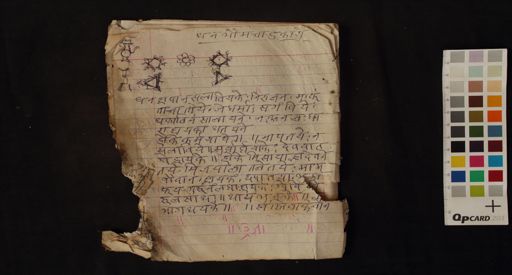
Tipot
eap_79003038 Language : Sanskrit & Newari Scripts : Nepālākṣara & Devanāgarī
This is a Buddhist composite text Tipot, in nepali language Tipot meaning a brief note or annotation. The text has not mentioned any known text name it has only including; Thanabhaumcādrakāye, Vicāravahlāyagu, Nikkajakkovarṣa, jakko, Thanasṃyyāke vidhāna, ahorātrou, Thanasvayamvayāyegu niyama. The mansucript is very damaged and it has written in modern copy in pen and has little 3 to 4 flower illustration on f.2, f.11 has a Grahamaṇdala illustration, f.19 has a male and female hand illustration, it sactually describes about the marrige rituals. The manuscript has not mention any date or text name and it is an incomplete text.
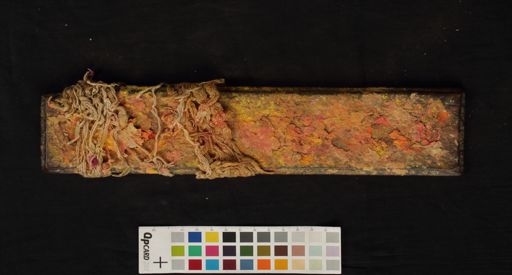
Arya Karanda Vyuha Mahayana Sutra
eap_79004001 Language : Sanskrit Scripts : Nepālākṣara
This is one of the nine Mahāyāna Vaipulyas Sūtras of eminence in Newār Buddhism. The central theme of the sutra is the compassion of the Bodhisattva Avalokiteśvara
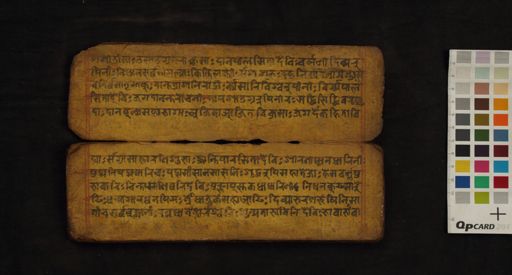
Vasundhara Hridayanama, Vajravidaraninama, Bhagvat Gita
eap_79004003 Language : Sanskrit Scripts : Nepālākṣara
This seems to be a composite manuscript with two separate manuscripts. The first manuscript contains the Vasundhara Hridayanama. Thapa labels the second manuscript as Bhagvat Gita, which seems to be misplaced. There is a colophon at the immediate end of the second manuscript and another, detailed colophon following it. The script of the colophon highly resembles modern Devanagari, indicating its composition in early modern period. The first colophon says--
Vetalakatha
eap_79004004 Language : Newar Scripts : Nepālākṣara
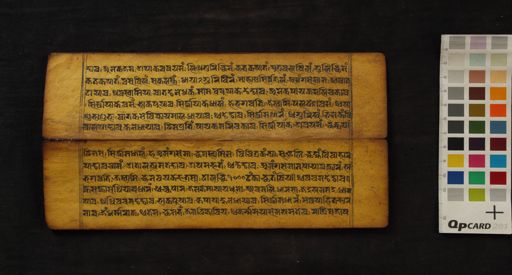
This is an incomplete composite manuscript. The scribe uses a mixed Devanagari and Newari script. Contrary to the title given by Thapa, this manuscript is actually Vetalakatha, or Vetala-Pancavimsatika, which is signified by colophons such as --'atha trtiyavetala' i.e. now begins the third Vetala katha. The manuscript does not have all of the twenty five stories and the collected stories are also not arranged sequentially.
Vetalakatha
eap_79004005 Language : Newar Scripts : Nepālākṣara
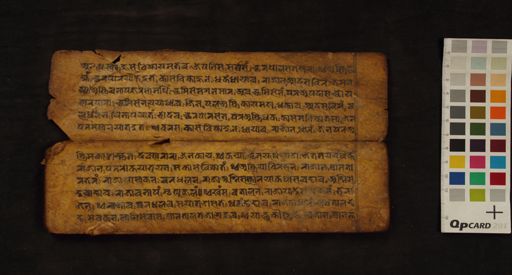
This is also an incomplete Vetalakatha manuscript, which starts with the fourteenth story. The condition of the manuscript is very damaged with no pagination. Letters are illegible at places
Unknown fragment
eap_79004006 Language : Newar Scripts : Nepālākṣara
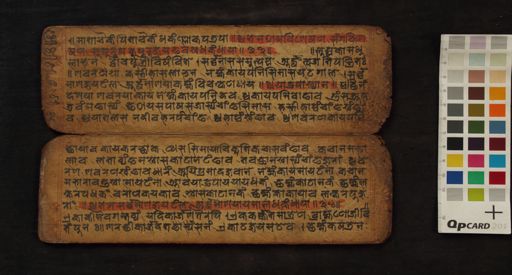
The contents of the manuscript are illegible, due to which Thapa has also titled it 'unknown'. It is an incomplete manuscript, the scribe seems to have known both Devanagari and Newari as he uses a combination of both at several places. From the content, this seems to be an 'upakhyana' text. The author states that it is meant for the 'dusta' students composed by a teacher/pandita. The text also claims that the impoverished will make material gains reading it.
Unknown drama on Ramayana
eap_79004007 Language : Bangla Scripts : Nepālākṣara
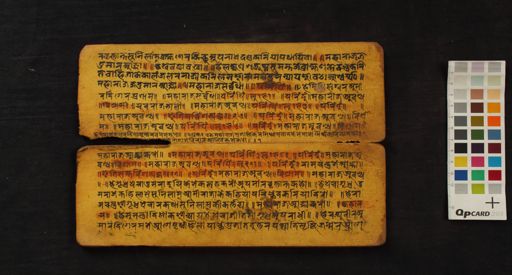
This is a composite manuscript which primarily constitutes a play that Thapa has named 'Raghuvira Shighra Gamana Katha'. The first folio mentions the end of the twenty-fifth act, whereas folio 5 mentions the conclusion of the thirtieth act. But the manuscript seems not to have arranged the play orderly. The context of the drama is also difficult to ascertain, in Folio 2 we find the term 'praja mithyavada' which can refer to Sita's departure from Ayodhya. Further in Folio 6, there is a mention of Ashvamedha, which strengthens the assumption that the play is based on the Uttarakanda of Ramayana. In folio 8, we find the abrupt conclusion of a stotra named Mohamudgara ascribed to Shankara. Further in folio 16 there is a reference to 'Bhaja Govindam'. It can be inferred that this is a part of the earlier mentioned Mohamudgara and the text is unarranged in the manuscript. Within folio 8 where Mohamudgara ends, there is also a brief text on the Mahabharata--which is further confusing. The manuscript is also interesting from an aesthetic perspective with illustrations on folios 11-13. One among them depicts Siva and Paravati in an erotic mudra with an incomplete stotra verse.
Krishna Bhajana
eap_79004008 Language : Newar Scripts : Nepālākṣara
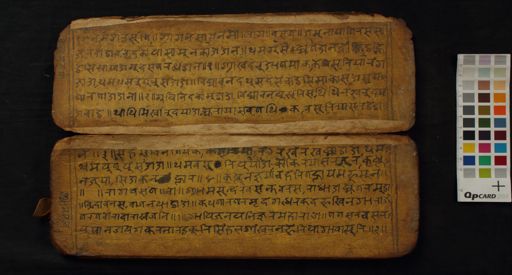
This is a stotra devoted to Krishna, which becomes clear by the mention of Krishna in the first folio as well as of motifs associated with him such as Vrindavana. The stotra uses Raga Vasanta for recitation which is specified before every quartet of verses. There are also some designs on the margins such as a swastika on a folio.