
Manuscripts
Search Filter
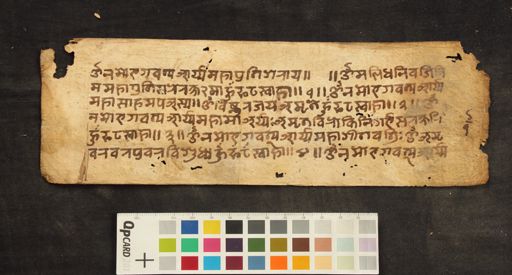
Ārya Mahāpratisarā
eap_79011009 Language : Sanskrit Scripts : Devanāgarī
Ārya Mahāpratisarā is a tantric stotra in the newari Buddhist tradition written in Sanskrit language in sūtra form. It is the first of the five Protective Sūtras in Mahāyāna Buddhism the Pañcarakṣā Sūtra. The text is used for recitation which is believed to offer protection from the female buddhist deity Mahāpratisarā also known as the eight armed godess who bears weapons which symbolically cut illusions. She is considered to be an emanation of The meditation Buddha. This manuscript has missing folios in the middle and lacks an ending.
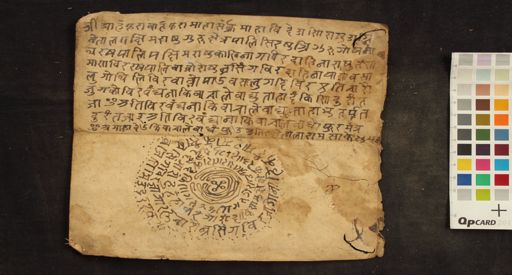
Mantras related to tantra
eap_79011010 Language : Newar Scripts : Devanāgarī, Pracalita Nepālākṣara
This manuscript appears to be a tantric mantra in a dialectic language form. The script is an unusual form of devanāgarī which has some syllables from the Nepal Akṣara script like the vowel 'E'. Below the main text there is a mantra written circular trajectory, encircling three broken rings and a cross symbol with small round ends at the points.
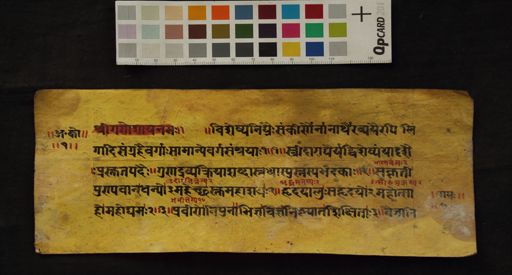
Amarakośa (Kāṇḍa-3)
eap_79011011 Language : Sanskrit Scripts : Devanāgarī
The title has been taken from the marginal abbrevation which reads A. Ko. The Amara kośa is a Sanskrit thesaurus or a type of lexicon which has categorized sanskrit words arranging them in verse form to aid memorization and classification. The text is a valuable resource for learners as well as scholars. It consists of three Kāṇḍas (chapters): (1) Svargādi-kāṇḍa, (2) Bhūvargādi-kāṇḍa, (3) Sāmānyādi-kāṇḍa. This manuscript only contains the third Kāṇḍa which contains adjectives, miscellaneous, homonyms, indeclinables and gender rules of words. The cover page contains a crescent moon dot symbol which generally represents Anunāsika symbol to indicate nasalization of the vowel and Rāma written in the centre. The main text is written in black ink but there is also over written marginal text below or above along side the text like a commentary. There appears to be a folio ordering problem as folio 56 is right after folio 15. rest of the folios are arranged mostly in correct order. Some folios appear yellow in colour because of arscenic for protection against rodents and insects alike. The Ms. is dated in Saṃvat 997.
Cāṇakyasāra saṃgrah
eap_79011012 Language : Sanskrit Scripts : Devanāgarī
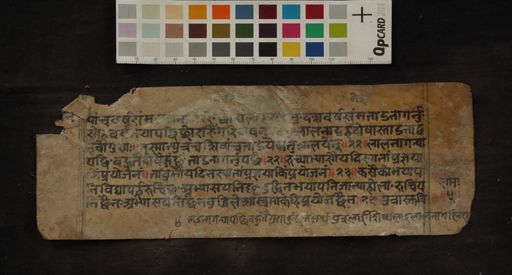
The text is Cāṇakyasāra saṅgrah the title is present in the intermediate colophon. The manuscript is incomplete as it lacks a beginning and end with some folios out of order. Some folios are damaged which seems to be due to rodent damage. The text is popularly read in Nepal to teach morals and ethics for the general public rather than statecraft, internal or external affairs. Different editions have different no. of verses. The text is attributed to Cāṇakya the author of Arthaśāstra, strategic advisor to the 4th-century BCE Emperor Candragupta Maurya. While some of the verses in the text may have been from his work the majority seem to be formulated by later scholars who wanted their work to be more acclaimed using Cāṇakya's name. Image 1–20: (f.5B–21A) 100 verses Image 20–52: (f.21A–44B) 100 verses Image 52–82: (f.44A–63A) 92 verses
Praśnapradīpa
eap_79011013 Language : Sanskrit Scripts : Devanāgarī
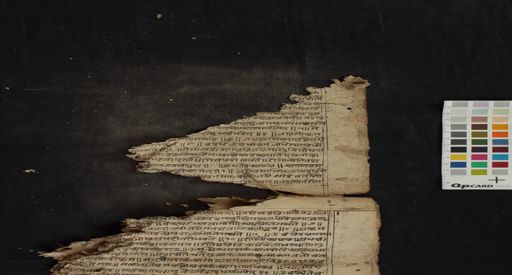
This manuscript is a Jyotiṣa text which is heavily damaged. It is hacked off from the left side, due to rodent infestation. It appears to be the work Praśnapradīpa/ Praśnadīpa composed by Kāśinatha from the intermediate colophon of what remains of the manuscript, the right side of the folio. The text is centered around the main topics of astrology containing 14 chapters.
Manuscript related to Tantra
eap_79011015 Language : Awadhi Scripts : Devanāgarī
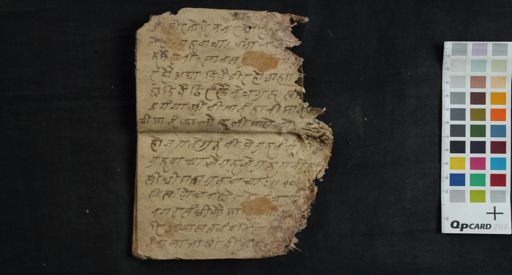
This manuscript is heavily damaged as half of the folios have been hacked off probably due to rodent damage but one side of the thread binding structure is still visible the folios have been binded like a book. The text is in Awadhi written in a more loose cursive style form of devanāgarī by the scribe which is slightly harder to read than the standard writting style. In the colophon text the letters do not contain vertical lines on top. Even though the manuscript is damaged the text is starting from the first folio. The cover page is blank. Title of the text is unknown. What is left visible in the left side of the folio shows many Bīja mantra-s and devotional tantric mantra-s which are serialized.
Devī Mahātmya (Part of Mārkhaṇḍeya Purāṇa)
eap_79013001 Language : Sanskrit Scripts : Devanāgarī
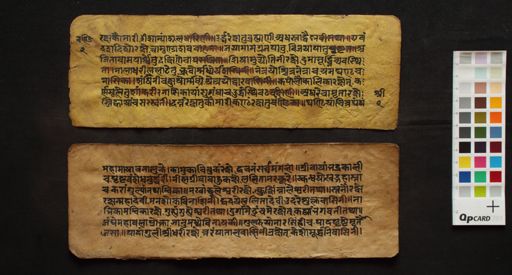
The text is Devī Mahātmya also known as Durgā Saptaśatī which is a devotional stotra consisting of 13 adhyāya (chapters) which places Devī as the supreme reality and all supreme female deities Sarasvatī, Lakśmi and Kālī as the manisfestation of the same devine power which is the basis for Śaktism philosophy. The text is part of the Mārkhaṇḍeya Purāṇa a major purāṇic text adhyāya 81–93 in precise also mentioned in the intermediate colophon. Adhyāya 1 – f.(1–4), Adhyāya 2 – f. 4–6, Adhyāya 3 – f. 7–18, Adhyāya 4 – f. 21–25, Adhyāya 5 – f. 25–31, Adhyāya 6 – f. 31–33, Adhyāya 7 – f. 33–35, Adhyāya 8 – f. 35–40, Adhyāya 9 – f. 40–43, Adhyāya 10 – f. 43–45, Adhyāya 11 – f. 52–54, Adhyāya 12 – f. 54–55, Adhyāya 13 – f. 55–56. The manuscript is mostly complete and in good candition. However folios 46–51 are missing and on some folios there are red bordered blank rectangles present in the middle of the text which probably were meant for illustrations of deities since Newari manuscripts are known for their coloured illustrations. The manuscript is dated Saṃvat 1854 Caitra Śudhi.
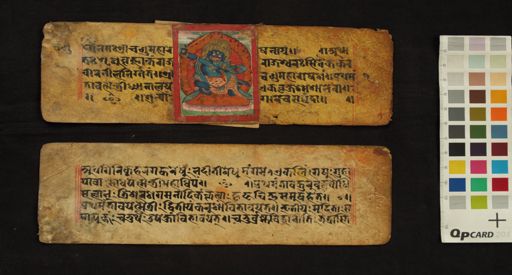
Siddhaiṣakallavīrapratibhedāntare Sahajodayarāsenāmābhisamayaṃ-Acalābhisamaya
eap_79014001 Language : Sanskrit Scripts : Nepālākṣara
This is a Buddhist Tāntric text containing mantras, bījamantras, and nyāsas in praise of Caṇḍamahāroṣaṇa, an emanation of the dhyāni Buddha Akṣobhya. Caṇḍamahāroṣaṇa is also known as Caṇḍaroṣaṇa, Mahācaṇḍaroṣaṇa, and Acala. The manuscript contains an illustration of Caṇḍamahāroṣaṇa on folio 1b. The manuscript begins with the Caṇḍamahāroṣaṇa-mantrarāja (f.1b–5a), followed by the Mantrapaṭala (f.5a–7a), Caṇḍamahāroṣaṇa-sādhana (f.7a–8b), Ekallavīra-prathama-pariccheda (f.8b–11a), Ekallavīrasya-cakāraparisūcanārtha-dvitīya-pariccheda (f.11a–12a), Ekallavīrasya-lalitakrīḍārthagrahaṇa-tṛtīya-pariccheda (f.12a–14a), and Ekallavīrākhye-vāhyavicāraṇa-caturtha-pariccheda (f.14a–15b). The manuscript also contains many small mantras dedicated to Caṇḍamahāroṣaṇa.
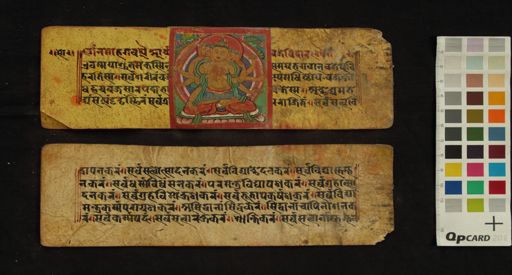
Āryyavajravidāraṇa-hṛdayamantradhāraṇī
eap_79014007 Language : Sanskrit Scripts : Nepālākṣara
A Dhāraṇī (spell) text dedicated to the deity Vajravidāraṇa (Vajra Conqueror), a semi-wrathful form of Vajrapāṇi. The text is said to have been imparted by Vajrapāṇi through the power and blessings of Śākyamuni and all the Bodhisattvas. It is believed that the text possesses healing and purifying powers. The manuscript contains an illustration of a Buddhist deity on folio 1b; although it appears to represent Vajravidāraṇa, the iconography does not match the illustration.
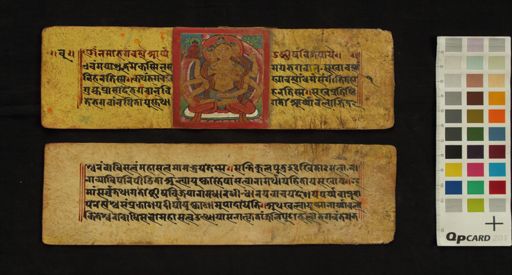
Uṣṇīṣavijayanāmadhāraṇī
eap_79014008 Language : Sanskrit Scripts : Nepālākṣara
This text contains mystical mantras bearing the name of Uṣṇiṣavijayā. These mantras were passed from Buddha Amitāyus to Avalokiteśvara. It is believed that these mantras are effective in curing diseases and promoting long life (Mitra, 1985, p. 267). The manuscript contains an illustration of Uṣṇīṣavijaya on folio 1b. He is believed to be one of the three long-life deities, along with Amitāyus and White Tārā.
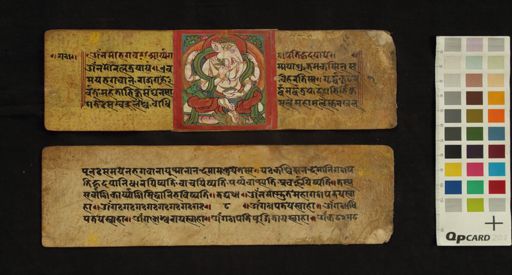
Āryyagaṇapati-hṛdayanāma-dhāraṇī
eap_79014009 Language : Sanskrit Scripts : Nepālākṣara
A dhāraṇī (spell) text dedicated to the deity Gaṇapati begins with a story in which Lord Buddha resides in Rājagṛha and gives teachings to his closest disciple, Ānanda. It is believed that the mantras in this text possess mystical power, such that anyone who wears, reads, or listens to them will have their wishes fulfilled (Mitra, 1985, p. 89). The manuscript contains an illustration of Gaṇapati on folio 1b.
Vasudhārāyānāmāṣṭottaraśata
eap_79014012 Language : Sanskrit Scripts : Nepālākṣara
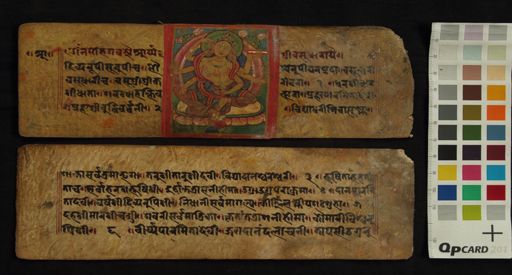
A mantra text composed in 24 verses, praising the Buddhist goddess Vasudhārā through her 108 names. The manuscript contains an illustration of Vasudhārā on folio 1b.